
A lot of great health businesses never get built. Not for lack of money or talent, but because of five letters:
HIPAA.
Short on time? Skip to the free checker →
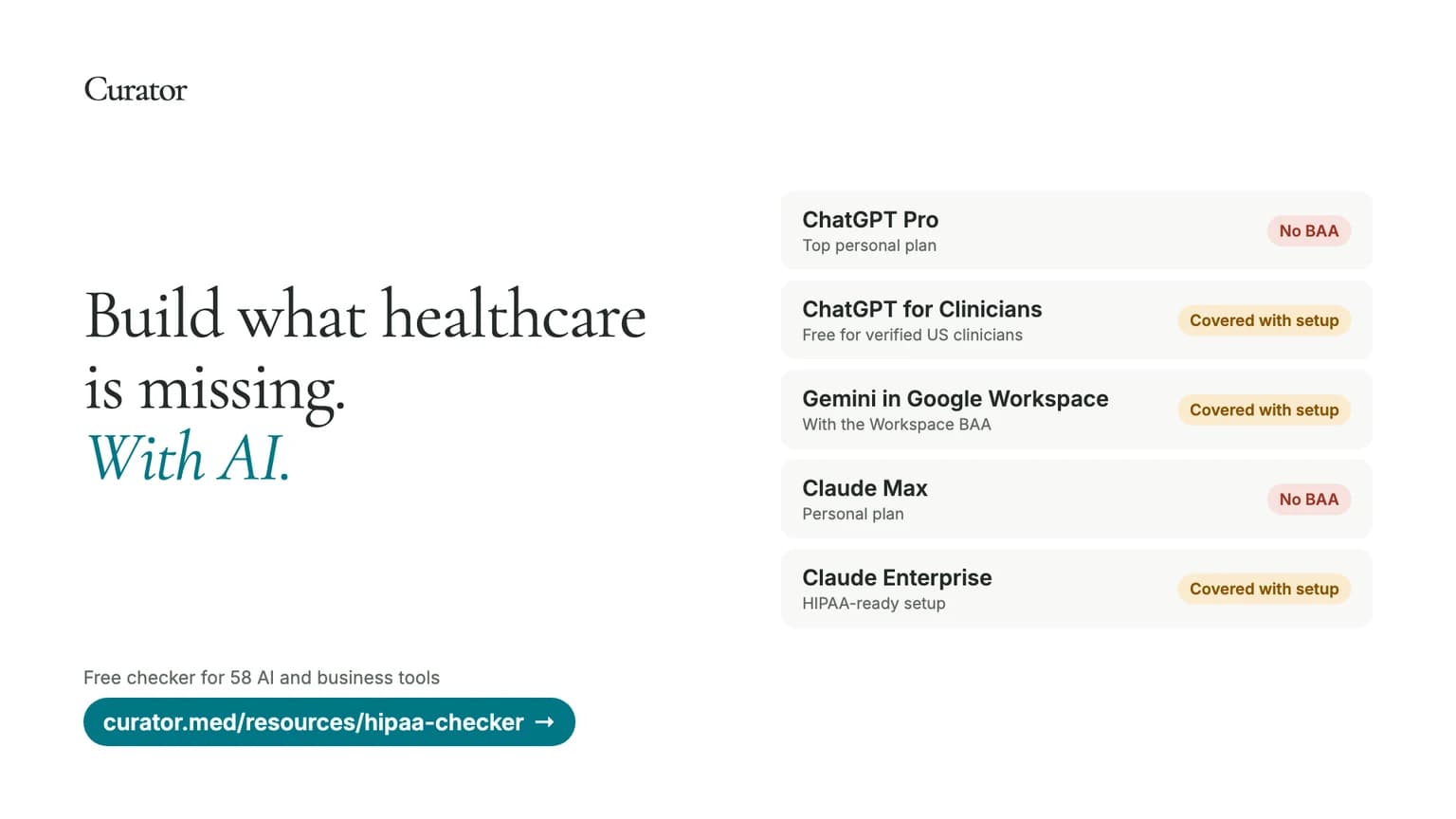
Here's what most people don't know. ChatGPT Pro can't touch patient data. ChatGPT for Clinicians can. And the great thing is, if you're a US physician, NP, PA or pharmacist, it's free.
Not a clinician? If your company runs on Google Workspace, Gemini can be covered under the same BAA you already accept for Gmail and Drive.
So HIPAA isn't about how much you spend. It's about which plan, which settings and which lane. Once you see that, it stops being a wall and starts being a map.
On October 29 I had about 10 minutes on Offcall's LinkedIn Live, with Graham Walker, Michael Hobbs and Sunita Mohanty, to cram all of this in. (Slides and resources here.) And the question I got most, there and everywhere else: “What tools should I use?”
Honestly? Start with the big AI platforms. They keep swallowing jobs that used to need their own app:
- Cited answers and letters: mostly built into ChatGPT and Claude now.
- Reading patient records: built into ChatGPT, partly into Claude.
- Scribing: only partly.
- The chart itself (prescriptions, labs, a patient app): neither does that.
They pick up a new job every few months. Watch them, and pay a specialist only for the gaps.
So many founders I talk to want to do more with AI, and then freeze. Because, HIPAA. That's the gap I want to close. This is the moment to build the healthcare we'd want for our own families, by people who actually know care, with AI doing the heavy lifting. It's why I started Curator: a platform, and a network, for the founders building it.
So I read the fine print on 58 AI and business tools and turned it into a free checker.
The tool
curator.med/resources/hipaa-checker
For every plan: will the vendor sign a business associate agreement (BAA), what to switch off, and a link to the vendor's own page with the date I checked it. I rechecked every claim in this issue on November 2.
The playbook
1. Pick the plan, not the price. ChatGPT for Clinicians is free and comes with a BAA you sign yourself (Settings, then Agreements). ChatGPT Pro doesn't, whatever you pay. Claude Enterprise can be set up for HIPAA; Pro, Max and Team can't. Building your own product? The OpenAI and Claude APIs both offer BAAs, with the right settings turned on.
2. Know the few switches that matter. Covered tools still have trapdoors. In ChatGPT for Clinicians, improved memory, tasks triggered by events (“whenever an email arrives”) and internet access for cloud agents sit outside the BAA. Turn those off for patient work. Same idea elsewhere: Gemini Notebook (formerly NotebookLM) isn't covered, even inside a Google Workspace that is. And the fine print moves. OpenAI's changed twice the week I prepped the talk, which is why every answer in the checker has a date on it.
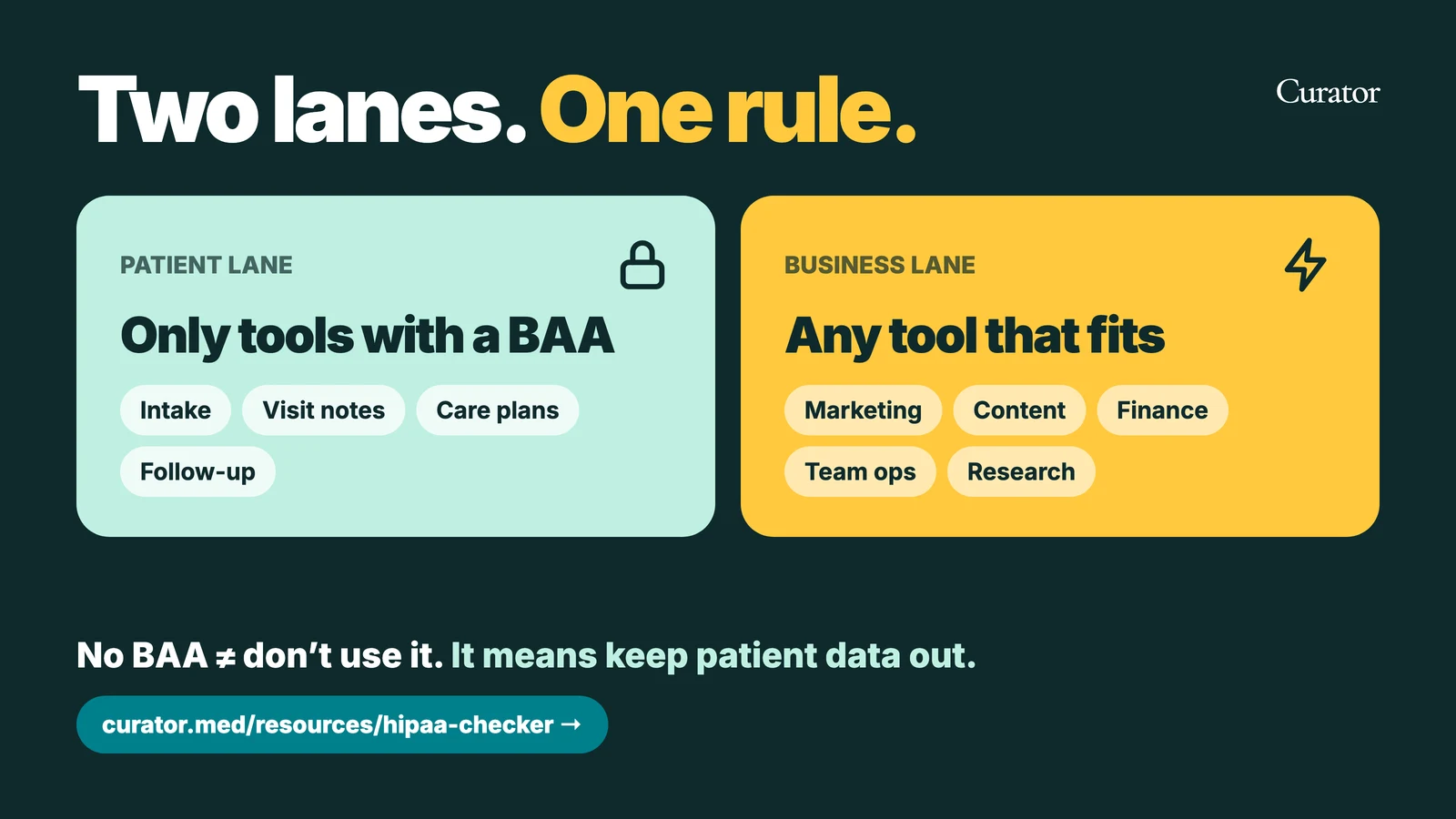
3. Build everything else boldly. “No BAA” doesn't mean “don't use it.” It means keep patient data out. Most of running a health business (marketing, content, finance, team ops) never touches patient data anyway.
Here's how I do it. I run a solo, virtual practice in 12 states, and I'm CEO of Curator. Patient work only goes through covered tools. Everything else, agents handle all day. Every morning I get one numbered list of decisions and reply from my phone: “1 yes, 2 warmer, 4 mine.” Nothing irreversible happens without a yes from me.
The rule isn't “avoid AI.” It's “know which lane you're in.”
One caveat: all of this matters if HIPAA applies to you. That's most clinics and practices that bill insurance electronically, plus the companies that handle their patient data: health tech, billing and many AI startups. Plenty of cash-pay and wellness businesses aren't covered, though other privacy rules can still apply. Not legal advice.
Know someone building in health? Send them the checker. It's free, and that's the point.
The question: what's stopping you?
If it isn't HIPAA, what's the hardest part of building right now? Finding patients or clients, pricing what you offer, making content, drowning in admin, or knowing where to start with AI?
Reply to any issue of The Curator Stack and tell me. I read every one, and what you tell me shapes what we build next.
One more thing. Want your work on Curator? We're building a directory of the people and brands building better care. Email “directory” to hillary@curator.med and I'll help you set up your page.
Don't let five letters be the reason you don't build. The tools will keep changing. The mission doesn't.
Hillary
Hillary Lin, MD Founder & CEO, Curator
P.S. HIPAA might be the only five letters scarier to founders than “Series A.” The checker should help with one of them. If it helped you, send it to one founder who needs it.